Discontinuedkit
1WSwitch: a serial port gateway to 1-Wire switches and sensors
1WSwitch was a small stand-alone board from Midon Design that sat between a PC serial port and a Dallas/Maxim 1-Wire bus. It watched switches and voltage sensors continuously, reported every change of state as it happened, and answered simple text commands, so any serial terminal or home automation program could read the bus without a driver.
- InterfacePC serial port
- SensorsUp to 60
- Poll interval1 to 99 minutes
- StatusDiscontinued
First published December 29, 2008 · Text rewritten 2026
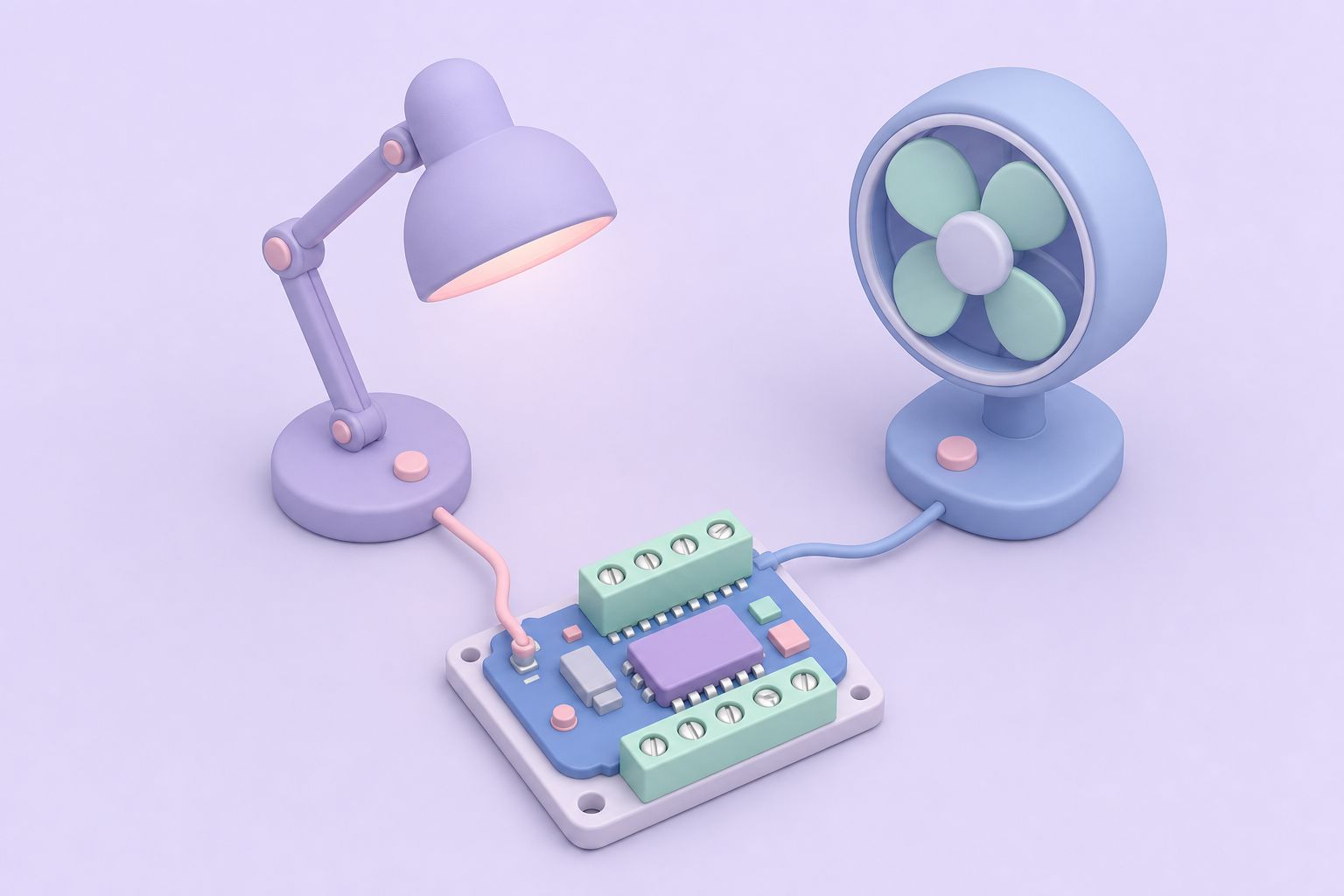
What the 1WSwitch did
Most 1-Wire adapters for the PC are thin bridges: they translate the bus timing, and software on the computer does all of the searching, addressing and reading. The 1WSwitch took the opposite approach. It carried its own processor and firmware, handled the 1-Wire bus by itself, and presented the results to the PC as plain serial text. The computer only had to listen to a serial port and send the occasional command.
The board had two ways of gathering data. First, it monitored registered switch sensors continuously and flagged a change of state the moment it saw one, which suited door contacts, float switches and other inputs where a delay of minutes would be useless. Second, it polled every registered sensor on a schedule, anywhere from once a minute to once every 99 minutes, and printed the current reading of each one. A manual poll command produced the same report on demand.
In a typical installation the 1WSwitch was wired to a spare serial port and left running. Serial interface software on the PC collected the text it produced and acted on it. Users connected it to HomeSeer, the Windows home automation package, and used the sensor readings to switch lights, heating and cooling, sprinklers and other equipment. Because the protocol was readable text, the same board could just as easily be driven from a terminal program during testing.
Midon Design discontinued the 1WSwitch before the company stopped selling at the end of 2023, and the kit is no longer produced. The design remains a useful reference for anyone building a self-contained 1-Wire controller, and the rest of this page describes what it supported and how it behaved.
Supported 1-Wire devices
The firmware recognized a fixed set of device types. Sensors from the list below could share one bus, up to a total of 60 registered devices.
| Device | Function on the bus | 1WSwitch limit |
|---|---|---|
| DS2438-based voltage sensor | Battery monitor chip with an A/D converter, used here to read voltages | Multiple |
| DS2405 | Single-channel addressable switch, input or output | Multiple |
| DS2406 or DS2407 | Dual-channel addressable switch, input or output | Multiple |
| 1WIO relay module (or equivalent DS2408 relay board) | DS2408-based board with four SPDT relay outputs | Up to 20 |
| 1WIO LED module | DS2408-based board driving up to eight LEDs | Up to 10 |
| 1WIO input module | DS2408-based board with four opto-isolated inputs | One |
The relay, LED and input modules were companion boards from the same product family. Their hardware is described on the 1WIO relay and input module page. The DS2408 is Maxim's eight-channel addressable switch, the same port expander the 1WIO boards use, so third-party relay boards built on that chip could stand in for the 1WIO relay module. Temperature sensors are not in the list: the 1WSwitch was a switch and voltage controller, while temperature logging was the job of the TEMP08 1-Wire temperature interface.
Monitoring, polling and bus diagnostics
Real-time state changes
For DS2405, DS2406 and DS2407 switches the board displayed state changes in real time. A contact opening or closing produced a line of output straight away, without waiting for the next scheduled poll.
Presence tracking
The continuous poll also covered presence. Once a sensor had been registered with the INI command, the 1WSwitch reported whenever it dropped off the bus or came back. That turned the board into a practical tool for chasing intermittent wiring faults: a loose connector or a marginal branch showed up as a stream of disconnect and reconnect messages that pointed straight at the problem device.
Bus errors and the on-board sensor
Errors on the 1-Wire bus itself were flagged as they occurred, and the board carried its own on-board voltage sensor in addition to any DS2438 devices on the network. Long or badly topologized networks are the usual cause of 1-Wire bus errors, and the 1-Wire network wiring guide covers cable choice and layout.
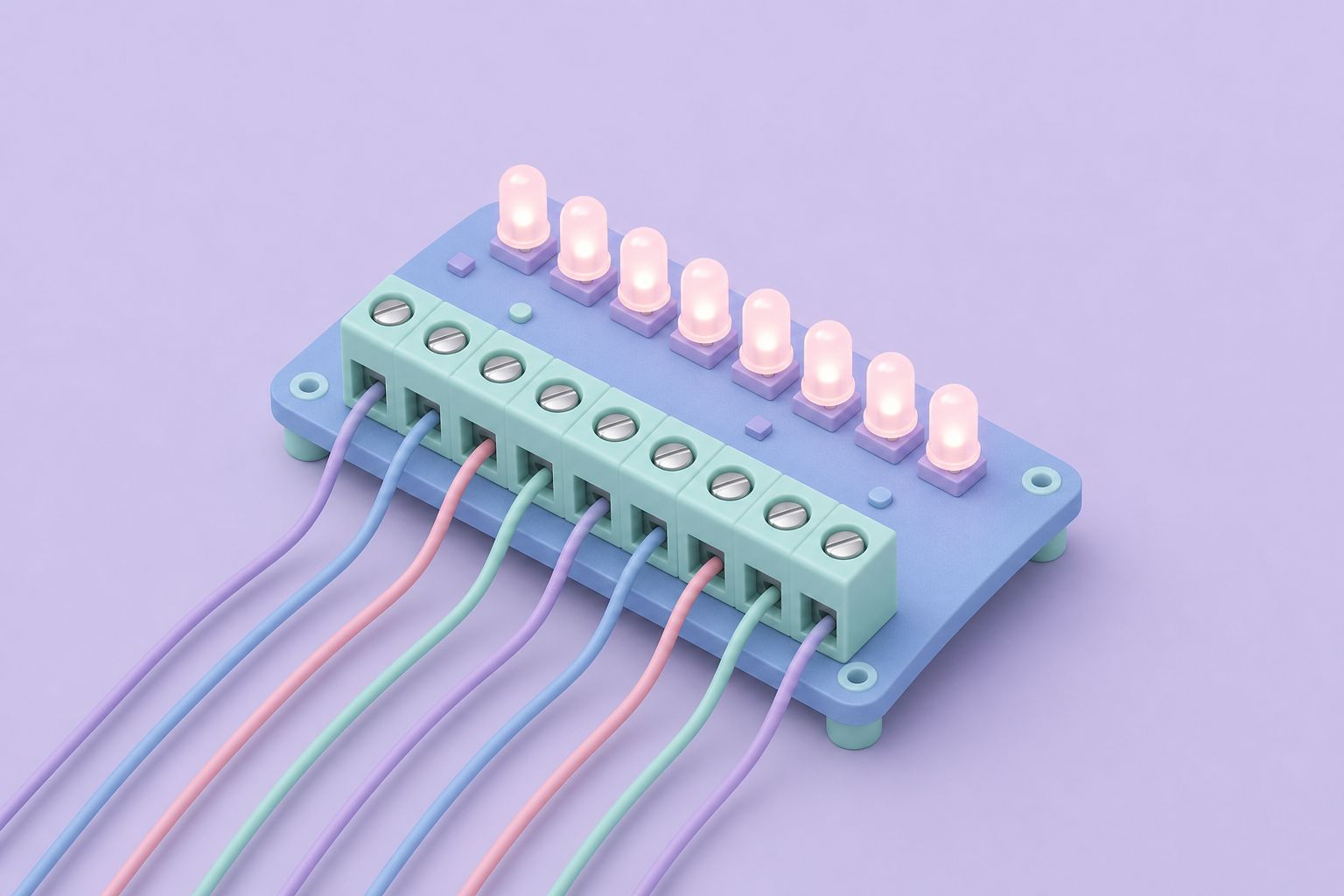
Setting it up without jumpers
All configuration lived in non-volatile memory, so there were no jumpers to set and the settings survived a power cycle. Commissioning followed a short routine.
- Connect the serial port. Wire the 1WSwitch to a spare PC serial port and open a terminal or serial interface program.
- Attach the sensors. Put the DS2405, DS2406, DS2438 and 1WIO devices on the 1-Wire bus.
- Register them. Issue the INI command so the board discovers and stores the devices it should watch. Only registered sensors are tracked for presence.
- Choose a poll interval. Set the scheduled poll anywhere from 1 to 99 minutes, or rely on manual polls.
- Tidy up later. Remove a sensor that is no longer needed with the DEL command. A built-in Help prompt lists the command names if one is forgotten.
The instruction set was kept deliberately small, which is why the board was easy to script from home automation software that could only send and receive text strings.
Where the design fits today
The 1WSwitch belongs to the period when the serial port was the universal way to hang a peripheral off a home computer, and when home automation software expected an intelligent box at the end of the cable. Its core idea, doing the 1-Wire work on a dedicated controller and exposing the results as simple messages, is still sound. Modern equivalents usually sit on a network rather than a serial line, but they solve the same problem of keeping bus timing away from a busy general-purpose computer.
For new projects, the common software routes are the Linux w1 kernel driver, which exposes many 1-Wire devices through sysfs, the OWFS file system for 1-Wire, and the Home Assistant 1-Wire integration, which reads its devices from an OWFS server. OWFS supports the DS2406, DS2408 and DS2438 family members that the 1WSwitch handled. What they do not replicate out of the box is its instant, unsolicited reporting of switch changes: most host-based setups poll, so the polling rate sets how quickly a contact change is noticed.
A summary of which sensor chips remain in production and how they compare is on the 1-Wire sensor overview.
Further reading: DS2438 smart battery monitor (Analog Devices) · DS2408 8-channel addressable switch (Analog Devices) · Home Assistant 1-Wire integration
Questions and answers
What was the 1WSwitch used for?
It connected a PC serial port to a 1-Wire bus and handled that bus on its own. It reported switch changes the moment they happened, polled voltage sensors and switches on a schedule of 1 to 99 minutes, and controlled 1WIO relay and LED modules, which made it a popular front end for HomeSeer and similar home automation software.
How many sensors could one 1WSwitch handle?
Up to 60 registered 1-Wire devices in total. Within that total the firmware accepted up to 20 1WIO relay modules or equivalent DS2408 relay boards, up to 10 1WIO LED modules and a single 1WIO input module, alongside any number of DS2405, DS2406, DS2407 and DS2438-based sensors that fit the overall limit.
Did the 1WSwitch read 1-Wire temperature sensors?
Temperature chips such as the DS18B20 were not in its supported device list. The board focused on addressable switches, DS2438-based voltage sensing and the 1WIO output and input modules. Temperature monitoring over a serial port was handled by the separate TEMP05 and TEMP08 interfaces from the same product line.
How did the 1WSwitch help find wiring faults?
Every sensor registered with the INI command was watched for presence. When a device dropped off the bus or reappeared, the board printed a message, and 1-Wire bus errors were flagged as they occurred. A flaky connection therefore showed up as repeated disconnect and reconnect reports for one device, which narrowed the search to that part of the network.
Can a 1WSwitch still be bought?
No. The 1WSwitch was discontinued, and Midon Design stopped selling altogether at the end of 2023. Comparable results today usually come from a USB or network 1-Wire adapter combined with OWFS, the Linux w1 driver or the Home Assistant 1-Wire integration, although those setups normally poll switches rather than reporting changes instantly.
Related pages
1WIO a Multi-Purpose 1-Wire Sensor
1WIO was a DS2408-based 1-Wire board with options for 4 SPDT relays, 4 opto-isolated inputs and up to 8 LEDs.
TEMP08 Serial One Wire Interface
TEMP08 linked a PC serial port to the 1-Wire bus: up to 60 sensors for temperature, humidity, rain, wind and relays, plus a real-time clock and RJ-12 jack.
Sensors
1-Wire sensor chips used with Midon Design kits: DS18S20, DS18B20 and DS1822 thermometers, DS2438 humidity, DS2423 counters, DS2450, DS2408 and iButtons.
1-Wire Network Wiring
1-Wire network wiring explained: linear bus versus star topology, CAT-5 pairs, cable length up to 300 ft, parasite power and RJ11 and RJ12 jack pinouts.
Products
All Midon Design 1-Wire kits in one catalogue: TEMP05, TEMP08, LOG08, 1WSwitch, 1WIO, relay boards and programmers, compared by host link, function, era.